
Issue 5: Data Centers, the Great Sorting, and Where Smart Money Moves Next
By Samiyah Ali
Editor's Note — This Week's Throughline
This issue reads like six different conversations, data centers outbidding builders for land, migration patterns reshaping who's leaving the US and who's arriving, capital gains and property taxes, a fall color palette, a mindset prompt. It's one conversation.
Location, location, location isn't a real estate cliche, it's the actual mechanism. Infrastructure decides location. Planes, trains, and automobiles, an airport corridor, a Brightline stop, a highway interchange, are what turn overlooked land into the next growth market before anyone else notices.
Proximity decides lifestyle. Where people live shapes where they shop, where their kids go to school, what they wear to the office, how they think about their own next decision. Infrastructure moves first. Real estate follows. Lifestyle, education, and shopping follow that.
Everything below is a different angle on that same throughline.
Real Estate Spotlight
By Samiyah Ali, Real Estate Broker, Global Premier Real Estate. 20 years in real estate, with a prior career as a Wall Street business analyst in development. I've worked through the 2008 crash, the post-9/11 bust, the 2012 reshape, and the 2020 reset. My authority here isn't a license, it's being in the room, having the conversations, and following the money before it shows up in the news.
Builders Are Getting Outbid for Land. In Florida, the Buyers Are Data Centers, and They're Already Here.
Home builders nationally are losing land bids to a buyer they've never had to compete with before. NAHB reported in July that AI data center developers are outbidding residential builders across the country, and the price gap isn't subtle. In Northern Virginia, Starwood Capital paid roughly $4 million an acre for a 42-acre county parcel. A developer offered Ashburn homeowners $4.4 million an acre to assemble a 130-acre site. Median land nearby sells for about $125,000 an acre, a 30-to-35x premium. The White House's own 2026 housing report puts the national shortage at 10 million homes.
Florida is not a spectator to this. The Fort Meade Data Center Campus in Polk County is converting 1,100+ acres of former phosphate land into a $2.6 to $2.8 billion build-out. Nassau County has a 1,600-acre campus staged near Jacksonville International Airport with 6,000 more acres of expansion potential next door. DeSoto County developers just sought rezoning on a 825-acre footprint. Even a Central Florida-based brokerage, La Rosa Holdings, has pivoted part of its own business into acquiring land for Tier III AI data centers in Osceola County. Florida's SB 484, effective this July, keeps data center power costs off residential ratepayers and preserves local zoning authority, so this is growth with rules attached.
What this means if you own land, not just a house: Power and access are the bottleneck, not raw acreage, which is exactly why sites near airports, major highway corridors, and existing transmission infrastructure are being assembled right now, often quietly. If you or someone you know holds 200+ acres in Florida within reach of an airport or a major commute corridor, that land is worth a conversation before it's worth a listing.
Local market snapshot: Volusia County's median sale price is $337,000, down 3.9% year over year, with inventory up 15 to 20% off 2024 lows. Seminole County sits at $396,000, with 29.5% of listings taking price cuts and homes moving in 57 days.
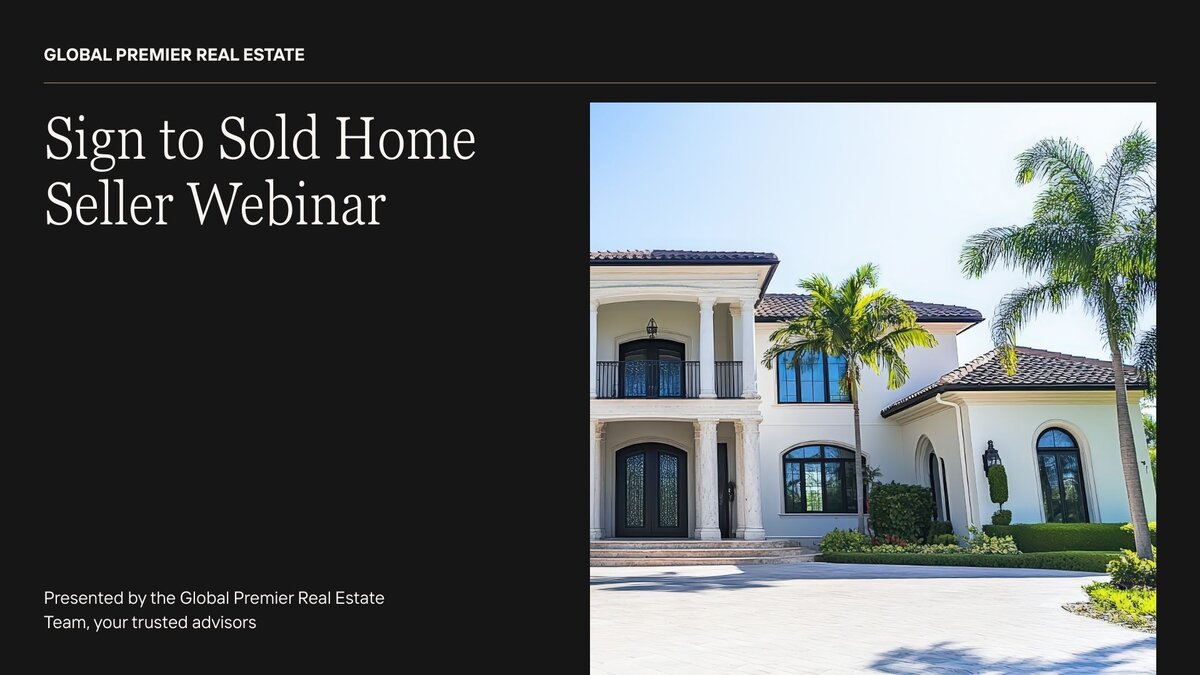
Get the full picture: Join the next Sign to Sold webinar, Tuesday, 6:00 PM Eastern. Reserve your seat →
If you own land: 200 or more acres in Florida near an airport, a major highway corridor, or growth infrastructure is a different conversation. That search box is anywhere Brightline and an airport align: Orlando International, Orlando Sanford International (Lake Nona, Sanford), and Daytona Beach International, with the added upside of proximity to the coast. Cocoa and Titusville count too. It doesn't have to be one contiguous 200-acre tract, we're just as interested in a cluster of adjoining or nearby parcels. And if you're a fellow agent with a client who owns land like this, we're glad to collaborate. Start the conversation →
Get in touch: [email protected] | [email protected] | 407-850-8323
Sidebar: Where Orlando Actually Grows Next
Downtown Orlando is where the luxury conversation starts, and where it hits a ceiling. It's landlocked, already congested, and has no real waterfront. It's not where the next Dubai-style luxury high-rise push happens.
Lake Nona is. It sits directly off the 417/528 corridor next to Orlando International Airport. In March 2026, Orlando city commissioners created the Dowden Central Community Development District, 380 acres specifically zoned for denser, mixed-use development around Medical City and Lake Nona's Town Center. Skylar, three mixed-use residential towers plus townhouses (625 units total), will be Lake Nona's tallest at 18 stories. Tavistock has a lakefront amenity center in the works on Lake Nona itself. Lake Nona West, a 405,000 square-foot lifestyle retail center opening summer 2026, is being built for one of the fastest-growing, highest-income submarkets in Florida. And Medical City, Nemours Children's Hospital, the VA Medical Center, UCF's College of Medicine, and the USTA National Campus give it an institutional anchor Miami and Dubai don't have. Brightline already connects MCO directly to Miami, Fort Lauderdale, and West Palm Beach.
The honest caveat: Lake Nona is nowhere near buildout, and 18 stories isn't Dubai's Marina skyline or Miami's Brickell yet. But the zoning just changed to allow it, and the towers are already rising.
The second, bigger answer: Cocoa and Titusville, the actual waterfront play, ahead of the market. On August 11, 2026, Brightline was awarded a roughly $57 million federal grant to fund final design through construction of its first-ever Space Coast station, in Cocoa, on a roughly 90-acre site near SR-528, US-1, and Clearlake Road. That station sits at the "Cocoa Curve," positioning Cocoa as a structural hub. Passenger service is targeted for 2029 to 2030. Layer that on top of SR-528, the Beachline Expressway, which already connects MCO to Cocoa Beach and Port Canaveral today, and you get the case for Cocoa: an existing highway corridor, an incoming Brightline stop, and genuine waterfront converging on the same few square miles, at land prices nowhere near Miami's. Cocoa's City Council recently approved a 7-story luxury apartment project (roughly 220 to 241 units, about $93 million) near Cocoa Village.
Titusville is the more speculative, longer-horizon companion play, the closest residential market to Kennedy Space Center, riding the same wave of SpaceX, Blue Origin, and NASA launch activity, record aerospace investment, and Amazon's recent land purchases in the area.
Put together, this is the actual land story: airport (MCO), highway (SR-528/Beachline), incoming rail (Brightline's Cocoa station), and waterfront (Indian River Lagoon, Atlantic beaches), all converging on Cocoa specifically, with Titusville as the earlier, cheaper entry point. It's the closest thing the Orlando region has to a pre-Brickell Miami, before the prices catch up to the infrastructure.
If this corridor is what you're watching, let's talk directly: Start the conversation →
Get in touch: [email protected]
Global Intelligence — The Great Sorting: Where People (and Capital) Are Actually Moving
By Samiyah Ali. Three decades of watching capital move, first as a Wall Street business analyst in development, now as a broker at Global Premier Real Estate.
For the First Time Since 1935, More People Are Leaving the US Than Arriving. Here's Where They're Going, and Who's Still Coming In.
This is the real story behind this week's Real Estate Spotlight. For the first time since the Great Depression, the United States posted negative net migration. Brookings puts 2025's outflow between 295,000 and 10,000 people and projects it could deepen to as much as 925,000 in 2026. That number reflects both Americans leaving and a sharp slowdown in immigrant arrivals under tighter enforcement, not a single simple story of an exodus.
A Wall Street Journal analysis of just 15 destination countries found at least 180,000 American citizens relocated abroad last year, and citizenship renunciations jumped 102% year over year. Cost of living (86%), safety (50%), healthcare costs (49%), and political climate (42%) were the top reasons cited. Top landing spots: Mexico, Portugal (up 500% since 2020), Spain, Ireland (up 96%), Canada, and Germany.
Where the smart money is buying, not just visiting:
Panama — a $300,000 real estate purchase currently buys permanent residency in as little as 30 to 90 days. That threshold rises permanently to $500,000 after October 15, 2026.
Grenada — a $270,000 fractional real estate investment (or $350,000 for sole ownership) buys citizenship in 3 to 6 months, plus visa-free access to 140+ destinations, and the only Caribbean citizenship-by-investment nation with an E-2 Investor Visa treaty with the US.
Costa Rica — the lowest entry point at $150,000, but temporary investor residency under Law 9996, not permanence.
Brazil — no residency required to buy at all. Foreign buyers picked up roughly $2.8 billion in Brazilian assets in the back half of 2025.
Dubai — the standout for momentum over a defensible five-year window: since the market's 2021 bottom, prices are up roughly 86%, and 2026 alone brought $78 billion in H1 sales.
And here's the twist: Florida is still winning the other side of this story. Florida posted a record 143.33 million visitors in 2025, Orlando hit a record 76.7 million, and Miami-Dade pulled in $22 billion in direct visitor spending. The traveler who keeps coming back to Central Florida for Disney or the coast is the same profile who eventually asks about buying here.
Growth rate versus market size, what an investor actually needs to know
The real comparison here is Dubai and Miami, not a four-way split with New York and Orlando thrown in. Miami is the world's second-largest market for branded luxury residential buildings, behind only Dubai, 48 completed branded towers with 55 more in the pipeline, versus Dubai's 64 completed and 87 planned. That's the same buyer: tech and high-net-worth individuals who want a turnkey luxury development, maintenance handled, the building already thought out. New York draws a different, more legacy-wealth buyer, and Orlando isn't in this comparison at all, its real estate is overwhelmingly single-family and family-oriented.
Over the five years since Dubai's market bottomed in 2021, prices are up roughly 86%, per Dubai Land Department's own price index. Miami's branded residences trade 30 to 65% higher per square foot than comparable non-branded Class A luxury towers, evidence Miami buyers are paying the same turnkey premium. Miami's broader luxury median rose 2.3% in Q1 2026 alone, 54.2% of Miami condo sales in January 2026 were all-cash, just a slower five-year pace than Dubai's.
The trade-off is volatility, not just speed. Dubai's history includes real drawdowns, a 50 to 60% drop in the 2008 crash and another 25 to 35% correction from 2014 to 2019. Miami hasn't seen swings that wide. Dubai has compounded faster over the past five years specifically, at the cost of deeper drawdowns in its down cycles, while Miami has grown steadier.
Dubai's average gross rental yield sits around 6.68 to 8%, backed by zero personal income tax and no recurring annual property tax. Miami runs 6 to 9% gross but drops to roughly 4 to 6% net once insurance, HOA fees, and property tax are factored in.
(General market information, not personalized investment advice.)
If you're ready to act on this, here's where we come in: If Miami development is what you're building toward, book a consultation. If you're looking to position yourself in Dubai instead, we have branded properties starting at $1,000,000, developments where everything is already handled for you. With inflation, Miami's inventory at a price point that actually matches Dubai's comparable branded segment is thin below seven figures, so $1 million and up is the honest apples-to-apples entry point on both sides. A down payment with financing, or the advantages of paying cash outright, either path is real. And if you're serious about buying, we'll sponsor your trip to see the properties in person. Book a consultation →
Get in touch: [email protected]
The question worth asking on camera or in the comments: what actually pulls you back to a place the second time?
Stay in the mix: Global market briefings drop first inside the newsletter. Subscribe →
Questions: [email protected]
Central Florida Buzz
A Local News Collaborative Is Gearing Up. So Is a New Chocolate House on the Coast.
The News Collaborative of Central Florida, born out of Central Florida Public Media, Central Florida Foundation, and Oviedo Community News, is pooling resources across outlets like the Orlando Sentinel, WKMG News 6, and Winter Park Voice for comprehensive 2026 election coverage.
On a lighter note: fall festival season is landing early. The Pierson Rodeo (Sept 18 to 19) and the Cats-daga Festival (Sept 19) are both worth a Saturday.
The dining question I actually want answered: I cook, and I love it, so when I go out, I'm not looking for a plate I could make at home. I'm looking for an experience. Lately that's been hard to find. So I'm asking you directly: what dining experience has actually blown you away recently?
If it helps frame what I'm chasing: I don't eat pork or avocado, not vegan though, I lean toward organic, fish and seafood over red meat (I'll cook my own steak, thanks), and I want genuine fusion, real cultural combinations, not a gimmick. I've traveled enough to build a real tolerance for heat and for the unfamiliar.
A few I'm planning to try: Soseki Omakase in Winter Park, Central Florida's first Michelin-starred spot, a 10-seat globally-inspired omakase counter. OMO by Jont, also Winter Park, Japanese-French, a 2026 James Beard finalist for Best New Restaurant. And Flavour Kitchen & Wine Bar in Cocoa Beach, Chef Jason Bunin's fusion menu leans into bold combinations like Spanish octopus and lamb.
AJ Chocolate House's new New Smyrna Beach location is still worth a stop for dessert, but it's not the answer to this question.
What dining experience has blown you away? Comment your spot, I'm building my list.
Questions: [email protected]
The Wealth Loop
Retirement Isn't a Pension Anymore. It's a Portfolio You Build on Purpose.
Two weeks of this segment, two pieces of the same puzzle. Last week: capital gains. This week: property taxes. Put together with how you invest and how you retire, they're four levers on the same loop.
1. Sell smart: know your capital gains number before you list. Under IRC Section 121, a single filer can exclude up to $250,000 of gain on the sale of a primary home, and a married couple filing jointly can exclude up to $500,000, as long as you owned and lived in the home at least 2 of the last 5 years.
2. Own smart: underwrite the tax line, not just the mortgage line. The Fed held rates steady in July and the 30-year fixed is sitting at 6.65%. Pull the last 3 years of property tax history on any address before you buy.
3. Invest smart: accelerated depreciation is back at full strength. 100% bonus depreciation is now permanent for qualifying property, and a cost segregation study can identify 20 to 35% of a rental property's cost basis as components that depreciate on much shorter schedules.
4. Retire smart: the 401(k) alone isn't the plan anymore. For 2026, the employee deferral limit is $24,500, with a combined employer-and-employee cap of $72,000. The Department of Labor's March 2026 proposed rule is opening the door for real estate, private equity, and other alternatives to sit inside retirement accounts for the first time.
(General information, not personalized tax or investment advice.)
Wealth Loop Book Club: A Land Remembered by Patrick D. Smith. Get the book → The Florida classic, following one family across three generations, from 1858 pioneers driving wild cattle through the Everglades to the 1968 descendant who watches the same land get sold off for development. Read it as the origin story for every "getting ahead of the market" conversation in this week's Real Estate Spotlight and Global Intelligence.
Want the worksheet? Comment "DECIDE" and we'll send it.
Stay connected: The Wealth Loop Book Club runs every issue. Join the book club →
Questions: [email protected]
The Style Edit
I've Been Saying It for Months. Chocolate Is the New Black. New York Just Confirmed It.
This isn't a new call. Earthy tones, sunrise into sunset warmth, chocolate as the new neutral, that's been the thesis on this desk for months. This week, New York Fashion Week's official Fall/Winter 2026-27 color report landed with almost the exact same story.
The palette: Toffee and Arabian Spice as the chocolate core, Muted Clay and Acacia carrying the sunrise-to-sunset gradient, Festival Fuchsia as the one bold statement pop.
Ensemble: A Toffee tailored blazer over a Candied Ginger silk camisole and wide-leg trouser, with one Festival Fuchsia statement piece. Gold hardware only.
Coming next: Orlando International Fashion Week's Fall Shows run November 8 to 15, and this palette is expected to be everywhere. I'll be there in person, seeking out the events, making connections.
No shop link this week, this one's about the point of view, not a purchase. Find me on social, and stay tuned for my style edits.
Questions: [email protected]
Mindset & Affirmation
Quote: "You don't need more information. You need to decide with the information you already have." — adapted from DECIDE
Affirmation: "I act on what I know today. Clarity comes from moving, not from waiting."
Reflective prompt: What's one decision you've been waiting on "more data" to make, when the real data you've been avoiding is just... a decision?
If you wish to shift your mindset, check in with DECIDE. It reads like a manual to the life you want from where you are. Get the book →
Questions: [email protected]
Agent Spotlight

Samiyah Ali is a real estate broker with Global Premier Real Estate and 20 years of real estate expertise. She began her career as a business analyst in development on Wall Street, three decades of experience total, most of it spent watching how capital and infrastructure actually move markets before the market itself catches up. She's worked through the 2008 crash, the post-9/11 bust, the 2012 reshape, and the 2020 reset.
That's the authority behind Real Estate In the Mix: not a license or a title, but two decades in the room, having the conversations, looking past what's in plain sight, and following the money before it becomes a story everyone else is telling.